
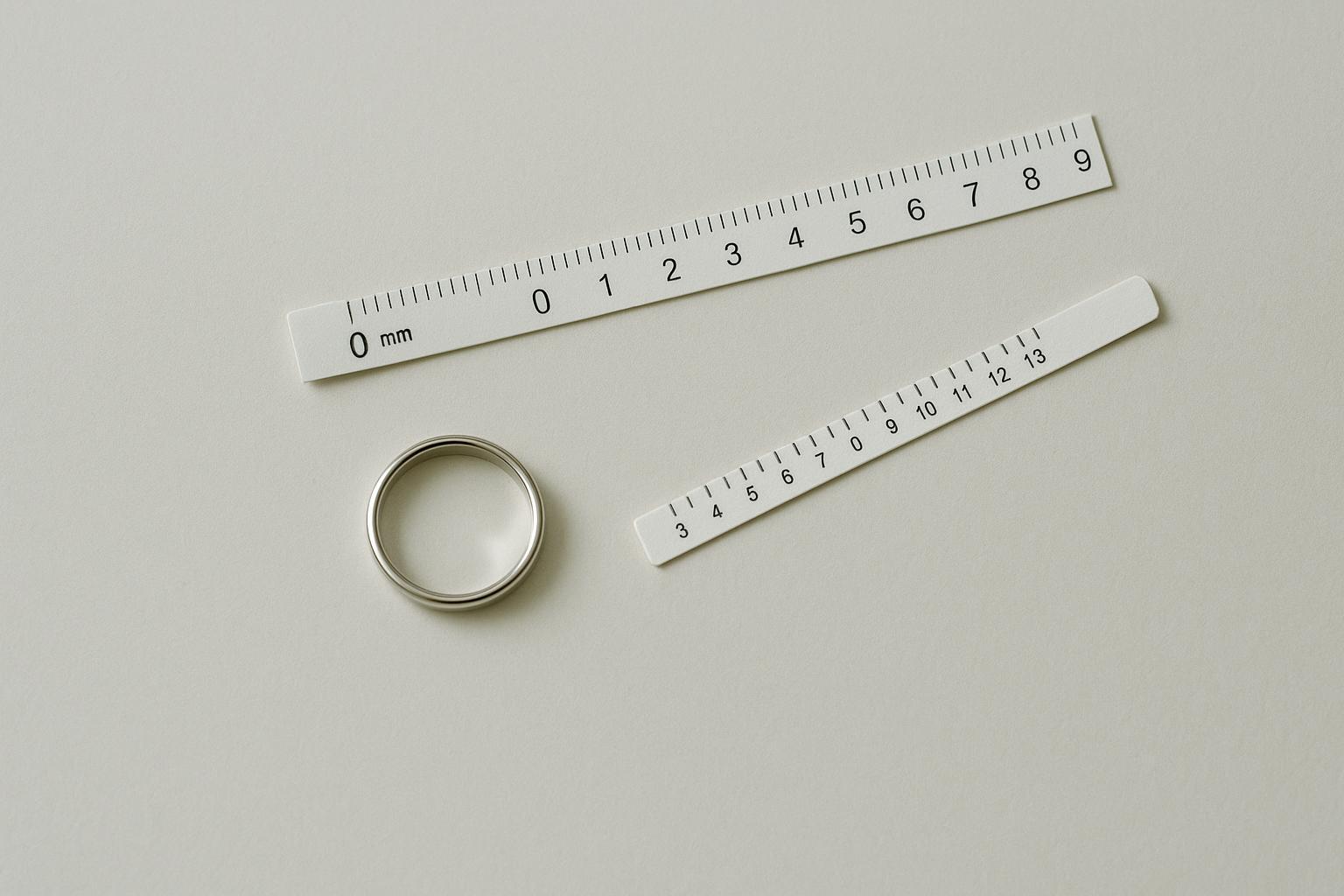
Buying a ring online is fun right up until you hit the dropdown that asks for your size.
If you want a number you can order with confidence, here’s the simplest rule: measure in millimeters, then confirm your US size using a chart—and (if you can) verify your result with a second method.
How to measure ring size at home: choose the right method
Use the method that matches what you have on hand:
-
You already own a ring that fits the correct finger: measure the inside diameter in mm (fast, reliable).
-
No ring to measure: measure your finger’s circumference in mm with a paper strip (this gives you a ring size in mm you can convert to a US size).
-
If you’re between sizes or ordering a wider band: plan on doing two measurements and reading the “Decision checks” section below.
Pro Tip: If you can, measure in the afternoon/evening at a comfortable room temperature. Fingers can change size with heat/cold, activity, and even altitude—GIA calls out these variables as common reasons people end up with the wrong fit in its ring sizing tips and chart.
Method 1: measure a ring that already fits (diameter in mm)
This is one of the cleanest ways to get a size—because you’re measuring the ring, not a finger that might be slightly swollen.
-
Pick a ring that fits the same finger you’re buying for.
-
Place it on a flat surface.
-
Use a ruler (or calipers if you have them) to measure the inside diameter straight across the center.
-
Measure in millimeters (mm), and repeat once to confirm.
Quick check: you’re measuring the inside edge to inside edge—don’t include the metal.
Method 2: measure your finger (circumference in mm)
If you don’t have a ring to measure, use a non-stretchy paper strip (paper is better than string because string can stretch). GIA specifically warns that string and paper methods can be error-prone if they stretch, curl, or don’t account for the knuckle—so the key is doing it carefully and verifying the result when possible.
-
Cut a strip of paper about 1/4–1/2 inch wide.
-
Wrap it around the base of your finger (where the ring will sit).
-
Pull it snug but not tight.
-
Mark where the end overlaps.
-
Lay the strip flat and measure the length in mm. That number is your finger circumference.
⚠️ Warning: If your knuckle is much wider than the base of your finger, your ring must slide over the knuckle and feel secure at the base. GIA notes that DIY methods often miss this detail—so don’t skip the “Decision checks” section below.
Convert mm to US ring size (mini US ring size chart)
Use this chart to match either measurement:
-
Inside diameter (mm) → US size
-
Inside circumference (mm) → US size
These values are commonly shown across ring size conversion charts; for a larger list and international conversions, see Brilliance’s Ring Size Conversion Chart (diameter and circumference in mm).
|
US size |
Inside diameter (mm) |
Inside circumference (mm) |
|---|---|---|
|
4 |
14.9 |
46.8 |
|
5 |
15.7 |
49.3 |
|
6 |
16.5 |
51.9 |
|
7 |
17.3 |
54.4 |
|
8 |
18.2 |
57.0 |
|
9 |
19.0 |
59.5 |
|
10 |
19.8 |
62.1 |
|
11 |
20.6 |
64.6 |
|
12 |
21.4 |
67.2 |
Decision checks before you order
This is the part that saves people from “it fits… but I hate wearing it.”
If you’re between two sizes
-
If you measured twice and keep landing between sizes: consider going up if you’re buying a wider band, stacking rings, or you know your fingers swell during the day.
-
If the ring is delicate/thin: staying closer to the smaller size can feel more secure.
GIA also notes that some ring styles can be difficult to resize, so it’s worth taking sizing seriously before you order.
If you’re buying a wide band or stacking rings
Wider rings have more contact with your skin, so they often feel tighter than a thin band in the same size. GIA notes that wide shanks (especially around 4–5 mm and up) may need special sizing consideration.
A practical approach:
-
If your band is wide (or you’ll stack multiple rings), consider sizing up about half a size if your measurements are borderline.
If your ring needs to pass over a knuckle
A good fit means:
-
It slides over your knuckle with a little resistance.
-
It doesn’t spin constantly once it’s seated at the base.
-
It doesn’t feel like it’s “cutting in.”
If this is tricky for you, it’s worth getting a quick professional sizing—GIA emphasizes jewelers use tools that account for real-world fit variables.
Common mistakes that lead to the wrong ring size
A few small errors are responsible for most sizing mishaps:
-
Measuring when your hands are cold or overheated. Temperature changes can shrink or swell fingers.
-
Measuring right after exercise or a long hot day. Swelling can push you into the next size.
-
Pulling the paper/string too tight (or letting it sit too loose). Either can shift the result.
-
Forgetting the knuckle. You might measure the base perfectly and still not get the ring on.
-
Relying on a single measurement. Two methods (or two readings) catch mistakes early.
Next steps: pick a ring with confidence
Once you’ve confirmed your US size, you can shop knowing the size dropdown won’t derail you. If you’re looking for artisan designs—from unique gemstone rings to wedding styles—you can browse JewelyKing rings or explore JewelyKing wedding jewelry.
If you’re still unsure, the most confidence-building move is simple: get sized once by a jeweler, then keep that number on file for future purchases.