
When my fiancé and I decided to skip the traditional white diamond and opt for an aquamarine engagement ring, I thought the hardest decision was behind us. After all, who could resist that breathtaking, crystalline blue—a hue that looks as though a stray ripple from the Maldives has been gently wrapped around your finger? However, once I actually stepped into jewelry boutiques and began diving down online rabbit holes, I realized I had stumbled into a whole new dilemma: Should I choose a lab-grown aquamarine or a natural, mined one?
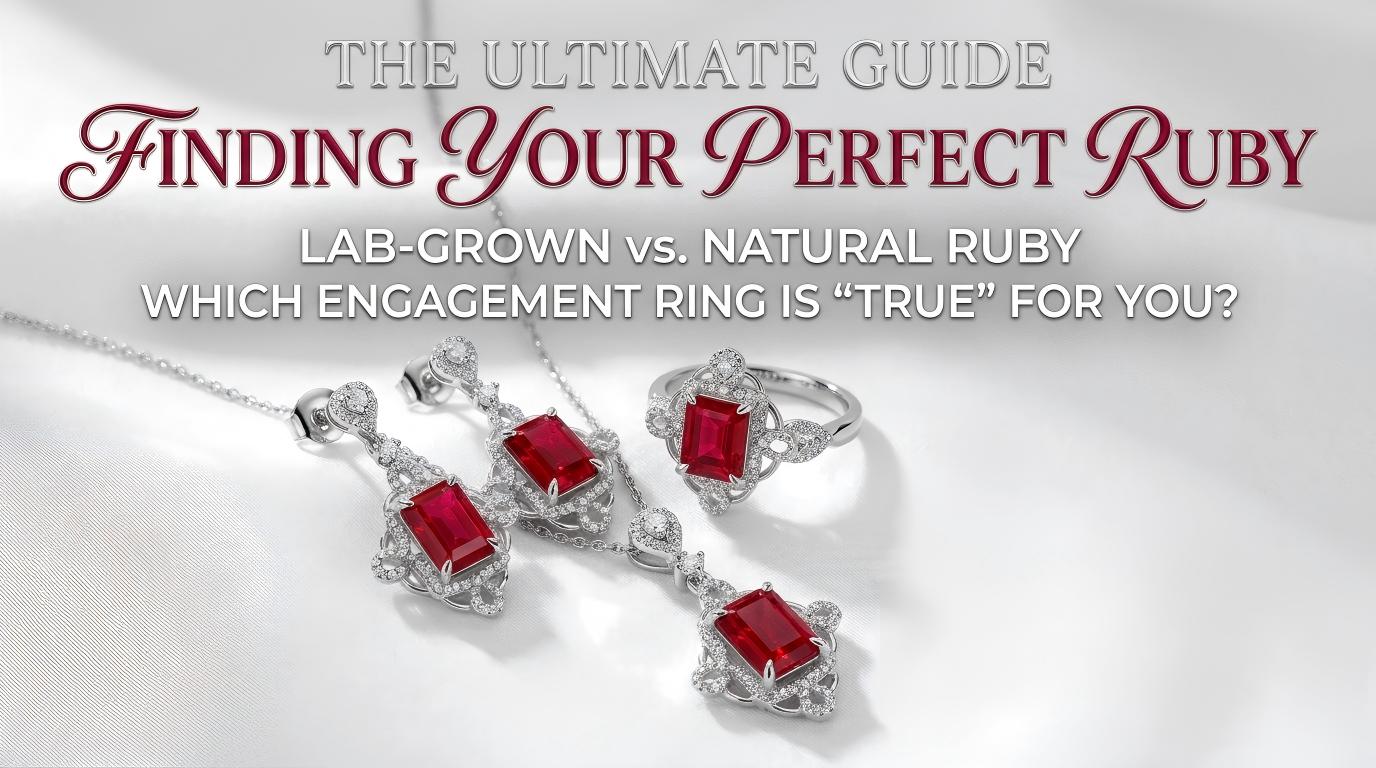
As an everyday consumer who wants a dream wedding without draining our future savings, I spent weeks researching, comparing stones under different lighting, and bothering gemologist friends. Today, I want to share my un-filtered journey with you, completely free of jewelry-store fluff, to help you navigate these beautiful but confusing blue waters.
As the American author O. Henry beautifully captured in one of his stories:
“The sky above was of that pale aquamarine tint that ballroom poets rhyme with 'true' and 'Sue' and 'coo.'”
Since this stone inherently symbolizes "truth" and lifelong commitment, how do we choose the right version of it to wear every single day?
1. Don't Let the Names Fool You: They Are Scientific Twins
First, let’s clear up a massive misconception that I initially held. When I first heard terms like "lab-grown" or "synthetic," my knee-jerk reaction was to think of cheap glass, plastic, or cubic zirconia. I worried that my friends would look at my finger and instantly spot a "fake."
I couldn't have been more wrong. A certified gemologist friend set me straight right away: Lab-grown aquamarine is absolutely not a fake simulant.
From a scientific standpoint, it is chemically, physically, and optically identical to a natural aquamarine. Both are members of the beryl mineral family and rank at 7.5 to 8 on the Mohs scale of hardness. If you put both under a high-powered microscope, they bend light the exact same way and exhibit the same brilliance. Their only true difference is their place of birth—one was formed deep within the earth, and the other inside a controlled laboratory.
2. The Perfectionist’s Choice: Flawless Clarity vs. Earth's Storybook
Standing in the showroom, I spent a long time examining both variants side-by-side. This is where the distinct "personalities" of the two stones truly shine through.
-
Lab-Grown Aquamarines: The Flawless Beauties
In a controlled environment, scientists recreate the precise temperature and pressure found in the earth’s crust, but without any of the chaotic dirt or unpredictable elements. Consequently, lab-grown aquamarines possess staggering clarity. They are virtually free of fractures or cloudy patches, boasting a pure, piercing "Santa Maria" blue—the gold standard of aquamarine color that is rich without looking dark.
-
Natural Aquamarines: The Poetry of Imperfection
Natural aquamarines took millions of years to grow deep inside the earth. During that lengthy, chaotic process, they naturally trapped tiny geological memories inside them—known as inclusions. While high-grade natural aquamarines can certainly be eye-clean, finding a deeply saturated, natural blue that hasn't been heavily heat-treated is incredibly rare, and the stone will often hold subtle, unique growth lines.
My Honest Take: If you crave a ring that looks utterly pristine under the afternoon sun—like a luxury photo filter come to life—lab-grown will satisfy your inner perfectionist. But if you find romance in the imperfect, viewing those microscopic internal characteristics as a sonnet written by Mother Nature over millennia, the living soul of a natural stone will win your heart.
3. The Reality Check: Listening to the Wallet
Let’s be completely transparent: engagement ring shopping is deeply romantic, but weddings, honeymoon flights, and future mortgages are very real financial responsibilities.
Price was the defining factor that forced us to evaluate our priorities logically.
| Feature | Natural Aquamarine | Lab-Grown Aquamarine |
| Price per Carat | Premium pricing (scales exponentially with carat weight). | Highly affordable (often a fraction or one-tenth of the price of natural). |
| Budget Impact (e.g., 2 Carats) | Might mean scaling back on a luxury honeymoon. | Frees up budget to upgrade the band to platinum or add a diamond halo. |
| Rarity & Value Retention | Holds intrinsic value due to natural scarcity and depleting mines. | Mass-producible through technology; carries minimal resale value. |
When you purchase a natural gem, you are paying for its scarcity and finite nature. When you buy a lab-grown stone, you are buying technological efficiency. If you are working with a strict budget but refuse to compromise on a show-stopping, large-carat center stone (say, 3 carats or above), a lab-grown gem is an absolute financial lifesaver.
4. Practicality on the Finger: Everyday Wear and Durability
This is a crucial detail that many excited couples overlook, and it is a point that high-commission salespeople might not emphasize.
Aquamarine has a Mohs hardness of 7.5 to 8. That sounds durable on paper, doesn't it? However, compared to a diamond (10) or a sapphire (9), an aquamarine is noticeably softer and demands a bit of tenderness.
Over years of daily wear, if you accidentally strike your ring against a granite kitchen counter, wear it to the gym, or keep it on while gardening, the sharp facet edges of the stone can get abraded or slightly chipped. This applies equally to both natural and lab-grown stones.
It is worth noting that because lab-grown stones lack natural structural fractures, they are theoretically a tiny bit more resilient against physical impacts than heavily included natural stones.
5. The Heart of the Matter: Eco-Conscious Tech vs. Timeless Heritage
Ultimately, the choice comes down to your personal ethos.
Many modern couples place high value on sustainability and ethical sourcing. Traditional mining inevitably impacts local landscapes and involves complex supply chains. Choosing a lab-grown aquamarine allows you to wear your ring with absolute peace of mind, knowing it represents a low-carbon, conflict-free, and eco-friendly lifestyle.
And yet, for me personally, an engagement ring is fundamentally an emblem of timelessness.
A prominent jewelry historian once noted that gemstones are the only tangible pieces of "forever" humans can actually hold in their hands. When I look at my natural aquamarine, knowing it silently crystallized in the pitch-black womb of the earth while dinosaurs still walked the planet, I feel a profound sense of destiny. That "billion-year-old" connection is something a machine-grown crystal created in a few weeks simply cannot replicate. To me, that romance is priceless.
The Verdict: Which Path Is Yours?
After weeks of weighing my options, I finally realized something comforting: There is no single "best" stone—there is only the stone that perfectly fits your lives, values, and relationship.
-
Go with a Lab-Grown Aquamarine if you:
-
Are practical with your finances and prefer allocating funds toward a down payment, travel, or an unforgettable wedding day.
-
Insist on absolute visual perfection and want a stone completely free of visible blemishes.
-
Are passionate about environmental preservation and love clean, modern technology.
-
-
Go with a Natural Aquamarine if you:
-
Are an unapologetic romantic who values historical depth, mystique, and absolute individuality in a gem.
-
Have a flexible budget and view your engagement ring as a precious heirloom to pass down through generations.
-
Are happy to offer a little extra care and patience to protect a genuine piece of natural luxury.
-
In the end, I chose a natural aquamarine with a very slight greenish-blue undertone and beautiful, eye-clean clarity. Every single time it catches the morning light on my finger, I feel an exquisite connection to the history of our earth. But I completely champion my friends who proudly wear lab-grown stones. Because at the end of the day, it isn't where the stone was born that matters—it is the love, honesty, and shared promises that cause it to truly shine.
I hope you find your own perfect splash of ocean to wear for a lifetime!